Every time I thought I was close to finishing this report, LinkedIn changed something.
That wasn’t an accident.
I was almost done toward the end of last year and then the platform shifted again. That’s when it clicked. These changes aren’t going away. They’re accelerating.
We’re heading toward a world where the algorithm doesn’t update a few times a year — it adapts constantly. Sometimes daily. Usually without warning.
So chasing tactics is pointless. Instead, this report takes a different approach. One that’s been battle-tested across multiple updates and still holds up.
Before we go any further, context matters.
This report isn’t based on vibes or one lucky post.
It’s based on analysis across 300,000+ LinkedIn posts, cross-referenced against multiple independent datasets, including one of the largest public studies of LinkedIn content behaviour to date (600,000+ posts analysed).
Different industries.
Different account sizes.
Different formats.
Same patterns showing up again and again.
That’s why the conclusions below are uncomfortable for some people.
And useful for everyone else.
The report is delivered in two parts:
No guesswork. No palm readers. No commenting for 33 hours a day hoping the algorithm notices you. No “just post more” advice.
Okay – I am probably going to tell you to post more.
But aside from that, we’re binning the cringe, skipping the sales pitch, and delivering an avalanche of value.
Let’s get cracking.
(If you publish on LinkedIn, bookmark this. You’ll come back to it.)
Let’s stop pretending something “broke”.
Most posts reaching fewer people isn’t an accident. It’s a deliberate design choice.
LinkedIn is no longer trying to give everyone a turn. It’s trying to protect attention.
There is more content than any user could reasonably consume. So the platform has to make a call and the call it’s making is this:
“We’d rather show fewer posts to people, but make those posts more relevant.”
That means:
This is why people feel like their posts are being throttled while simultaneously seeing other posts everywhere.
Both things are true.
The algorithm isn’t punishing creators. It’s filtering harder.
If your content doesn’t clearly earn attention, it doesn’t get distributed.
Simple. Brutal. Intentional.
To put numbers on this:
Across large-scale datasets, average organic reach is down roughly 30–35% year-on-year for the majority of users.
Not some users.
Not new accounts.
Almost everyone.
At the same time, outlier posts are travelling further than ever.
This is not a contradiction.
It’s concentration.
This is where most people lose the plot.
They think niche is about branding. It’s not.
It’s about pattern recognition.
The algorithm is constantly asking:
“Do we know what this person is known for?”
If the answer is yes…. distribution becomes easier. If the answer is no — every post is treated like a first post.
That’s why:
You don’t need to be the best in the world. You need to be consistent enough that the system can categorise you with confidence.
Authority on LinkedIn isn’t claimed. It’s inferred.
And once it’s inferred, reach compounds.
Likes are cheap. Comments can be faked. Time can’t.
The single most reliable signal on LinkedIn right now is how long someone spends with your post.
Do they stop scrolling? Do they expand it? Do they finish it? Do they scroll back up?
That’s why:
This isn’t about writing essays.
It’s about earning attention all the way through, not just winning the first line.
The algorithm doesn’t care if people start your post.
It cares if they stay.
Here’s what the data makes very clear:
Posts that keep people reading for longer outperform others even when:
Time spent > reaction count.
This is why longer, well-structured posts now consistently outperform short, punchy one-liners across median reach.
This is a subtle but critical shift.
Not all comments help you. Some do nothing. Some actively dilute your reach.
LinkedIn looks at:
Twenty low-quality comments ≠ meaningful engagement.
One thoughtful comment from the right person can outperform all of them.
That’s why:
The algorithm isn’t counting comments.
It’s evaluating interaction quality.
There’s also a big difference between comments and conversations.
Posts with replies to comments (what the data calls indirect comments) consistently see 2x+ distribution compared to posts where all comments sit at the top level.
In other words:
Threads beat applause.
One of the strongest signals in the data isn’t visible at first glance.
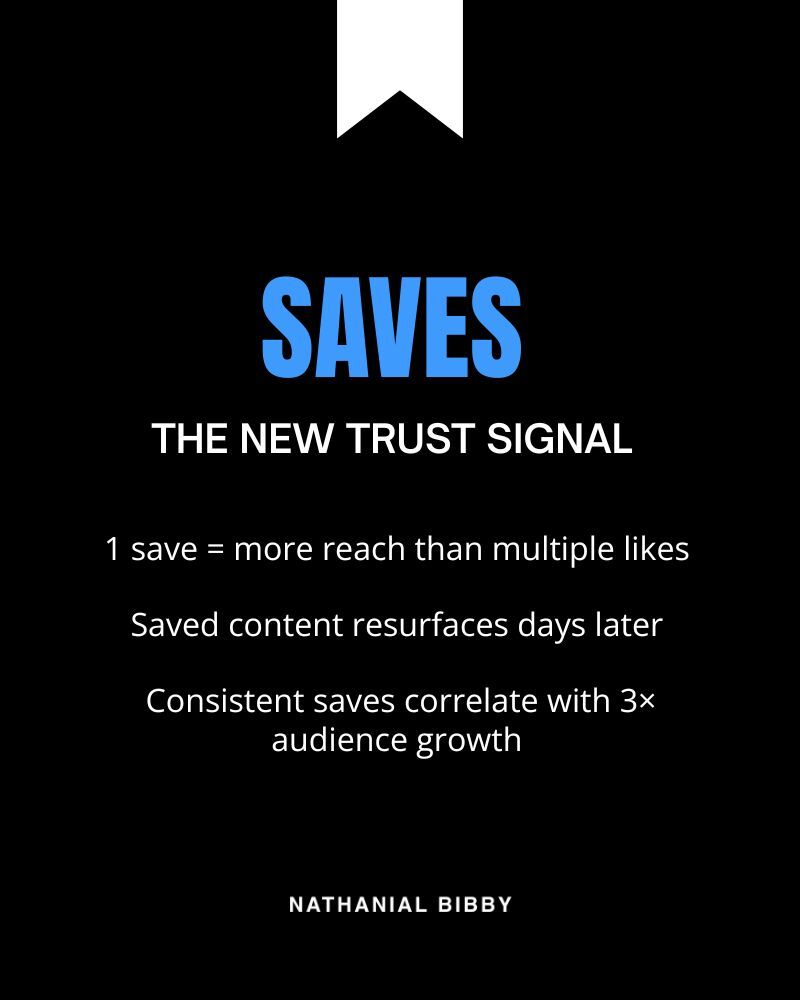
Saves.
Less than 3% of posts get saved.
But when they do, distribution changes.
On average:
Likes are noise.
Comments are conversation.
Saves are intent.
Carousels don’t win because they’re trendy.
They win because they force behaviour LinkedIn loves:
Each swipe is a micro-signal that says:
“This is worth spending time on.”
That’s it.
It’s not the format. It’s the interaction.
Bad carousel? Dies. Good text post? Can still fly.
Formats don’t win. Behaviour does.
Format performance data backs this up.
Document-style posts (carousels, PDFs) continue to outperform other formats on relative reach, even though absolute reach is down across the board.
Not because the format is favoured.
Because it reliably increases dwell time, scroll depth, and saves.
The algorithm doesn’t love carousels.
It loves what people do with them.
This myth needs to stay dead.
LinkedIn doesn’t suppress posts because they contain links. It suppresses posts people don’t engage with.
If users:
Distribution continues.
If they don’t, it stops.
The algorithm doesn’t care where attention goes. It cares whether attention existed in the first place.
In other words, putting a link in your post won’t hurt your reach, but if everybody who reads your post is leaving LinkedIn because of it, you can’t expect the algorithm to do you any favours.
Research shows that putting 3 links actually performs better than putting 1 link in the post.
Why? Less salesy, more likely to be research driven.
Link behaviour is more nuanced than people think.
Posts with a single outbound link early tend to underperform.
Posts with no links often perform better.
But interestingly, posts that reference multiple useful links (3–5) often recover reach because they look less promotional and more research-driven.
It’s not links that hurt reach.
It’s intent.
Let’s kill this one properly.
Hashtags do nothing meaningful for reach.
They don’t boost distribution. They don’t unlock audiences. They don’t “tell the algorithm what your post is about”.
That might’ve been true years ago. It’s not now.

LinkedIn already knows:
It gets that from language, behaviour, and past patterns — not a few words you stick at the bottom of a post.
If hashtags were a major lever, you’d see wildly different performance when people used them well versus badly.
You don’t.
Great posts with zero hashtags still fly. Average posts with five hashtags still die.
That tells you everything.
At best, hashtags are ignored. At worst, they’re visual clutter that signals “I’m following outdated advice”.
If you’re still spending time debating whether to use 3 or 5 hashtags, you’re optimising the wrong thing.
The algorithm doesn’t need labels.
It needs signals.
And hashtags aren’t one of them anymore.
Posting every day doesn’t help if you’re confusing the system.
The algorithm rewards predictability of value, not volume.
If today you’re teaching.
Tomorrow you’re ranting
Next day you’re storytelling.
Then suddenly selling.
You reset trust — with both people and the platform.
Two strong posts a week on the same theme beats five scattered ones every time.
Consistency isn’t repetition.
It’s coherence.
Here’s the final mental shift for 2026.
The algorithm isn’t becoming chaotic. It’s becoming behaviourally stable.
What’s changing constantly are tactics. What’s staying the same is what it rewards:
Creators who chase hacks feel like the rules keep changing.
Creators who build authority barely notice updates at all.
Because they’re aligned with the system, not trying to outsmart it.
| Factor | Old | New |
|---|---|---|
| How it reads content | Tracked IDs, clicks, hashtags, post times | Reads full text like a human, understands meaning and context |
| Profile importance | Profile was metadata for the network graph | Profile determines topic classification and content distribution |
| What engagement means | All reactions roughly equal; volume matters most | 1 save = 5× impact of like; depth matters more than volume |
| Hashtag value | Primary topic signal; essential for discovery | Minimal impact; model reads full text for topics |
| Post format priority | Constantly shifting (polls, then video, then docs) | Focuses on clarity and topic depth; any format can perform if content is stro |
This is the part people try to skip.
They want reach without a point of view. Leads without trust. Sales without being known.
That era is done.
The algorithm increasingly routes content through people, not pages, not topics, not formats. Which means who you are matters as much as what you say.
Personal brand isn’t about colours, fonts, or clever bios. It’s about patterned familiarity.
When someone sees your post, they should instantly know:
If your content could have been written by anyone, it will perform like it came from no one.
The safest long-term play on LinkedIn in 2026 isn’t chasing formats.
It’s becoming recognisable.
Across the data, one pattern is boringly consistent:
Posts from personal profiles outperform company pages by a wide margin.
When we compare like-for-like content (same topic, same format, similar audience size):
Why?
Because LinkedIn distributes content through human trust graphs, not brand affinity.
The algorithm is better at predicting:
Than it is at pushing corporate content into feeds.
This is why:
Personal brand isn’t “nice to have” anymore. It’s the primary delivery mechanism.
Across multiple datasets, personal profiles outperform company pages by a wide margin.
Like-for-like comparisons show:
Organic company page content now represents a tiny fraction of what appears in the feed.
People beat logos.
Every time.
If you’re ignoring events, you’re leaving leverage on the table.
LinkedIn events:
Events look small on the surface. In the data, they punch well above their weight.
Compared to standard posts:
Why this matters algorithmically:
Events create clustered behaviour:
That pattern tells LinkedIn:
“This isn’t random. This is intentional attention.”
Which leads to wider distribution across related content.
Events don’t go viral. They accumulate trust.
And trust compounds.
Event-related posts consistently outperform standard posts because they create clustered behaviour:
Multiple notifications.
Repeat profile views.
Engagement before and after the event.
From an algorithm perspective, this looks like intentional attention — not random scrolling.
That’s why events punch above their weight.
Check out the masterclass on LinkedIn events on YouTube with Jasmin Alic’s Link Up Community (link below).
This one confuses people.
In isolation, video doesn’t always outperform text on raw reach.
But when you look at downstream signals, video dominates:
Across analysed accounts:
The algorithm treats video as a confidence signal.
Showing your face:
Text builds credibility. Video builds belief.
The strongest accounts use both.
And let me tell you something that didn’t show up in any of the reports I read.
This is straight from the horse’s mouth. (And by horse, I mean mine.)
LinkedIn will release something this year that materially changes how video works on the platform.
I’m not talking about another minor tweak. I mean a genuine shift — the kind that changes how creators build trust, how audiences engage, and how quickly relationships form.
Call it intuition. Call it pattern recognition. Call it being on this platform long enough to feel when something’s coming.
Just do me a favour.
When it drops later this year, come back to this article and leave a quiet little “you were right” comment.
I’ll pretend I didn’t enjoy it.
Video doesn’t always win on raw reach.
But it dominates downstream behaviour.
Viewers of video content are 2–3x more likely to:
The algorithm treats video as a confidence signal.
Humans do too.
Looking at conversion paths, one thing is clear:
High-performing DMs almost always follow public interaction first.
The data shows:
In simple terms:
Accounts generating consistent inbound revenue show the same pattern:
DMs aren’t a growth channel. They’re a conversion layer.
The highest-converting DMs almost always follow public interaction first.
Cold messages have low response rates.
Warm conversations convert dramatically higher.
Public content creates demand.
DMs convert it.
Click here to get your free LinkedIn messaging templates.
This one surprises people.
Posting more helps — up to a point.
But the data shows diminishing returns when posting frequency increases without:
Accounts that:
Outperform daily posters who disappear after hitting “publish”.
Why?
Because LinkedIn tracks reciprocal behaviour.
It’s not just:
“Did you post?”
It’s:
“Are people interacting with you back?”
Relationship density > content volume.
One more thing:
Posts no longer live for 24 hours.
High-quality posts with ongoing interaction now resurface in feeds for days — sometimes weeks.
If this post is still showing up for you now, that’s not luck.
That’s the algorithm doing exactly what it’s designed to do.
This one is brutal — and consistent.
Posts with:
Underperform on:
And worse — they reduce engagement on future posts.
Why?
Because the algorithm optimises for user satisfaction over time.
If people consistently scroll past your sales content, LinkedIn learns:
“This account reduces feed quality.”
That doesn’t just affect one post.
It affects the next ten.
The accounts that scale best:
Selling isn’t punished. Premature selling is.
When you step back and look at all 300,000+ posts together, one truth stands out:
The algorithm rewards signals of human relevance, not creator effort.
That means:
People who try to hack the system feel like it’s unstable.
People who align with how humans actually behave barely notice the updates.
That’s not an accident.
That is the algorithm.
Let’s have a quiet word.
If your LinkedIn strategy is:
Congratulations. You’re playing the two worst games on the platform.
One makes you invisible. The other makes you briefly famous and permanently untrusted.
Both are exhausting.
Here’s a radical idea instead:
Stop pissing people off. Start adding value.
Not “value” like:
“Here are 5 things you already know, but in a Canva template.”
Real value.
The kind where someone finishes your post and thinks:
“Ah. That actually helped.”
Because here’s the bit LinkedIn gurus whisper, but never write in big letters:
Likes don’t pay the bills.
They don’t convert. They don’t compound. And they definitely don’t explain why your calendar is still empty.
Likes are applause. Businesses are built on trust.
Different game.
(Yes, This Is Where Most People Panic)
Everyone wants to “stand out” — just not in a way that makes anyone uncomfortable. Which is adorable. And completely ineffective.
If your content sounds like:
Then the algorithm does what humans do too.
It scrolls.
Standing out doesn’t mean being loud. It means being clear.
Clear about:
If you’re for everyone, you’re memorable to no one.
Despite what the internet says, LinkedIn isn’t sitting there thinking:
“How do we promote the most unhinged person today?”
It’s asking something much simpler:
“Did this make the feed better or worse?”
Did people stop scrolling? Did they read? Did they come back tomorrow? Or did they sigh and mute you?
You can annoy your way to attention. You cannot annoy your way to authority.
And authority is what actually compounds.
Which one of these algiruthm shifts have you been fighting instead of working with?
Add value consistently. Say something useful without acting superior. Be opinionated without being a dick. Build trust in public. Sell in private.
That’s it.
No hacks. No secret posting times. No commenting on 73 posts a day like it’s a full-time job.
Just clarity, usefulness, and a bit of personality.
Wild, I know.
This isn’t a scroll-and-forget post. Save it. You’ll need it when the next update drops.
Before you alt+tab back into Canva, let me leave you with this:
The algorithm follows people. People follow value.
Everything else is noise.
Want to start growing your business on LinkedIn? Check out my agency Bibby Media Group or get in touch directly and let’s chat.
Set goals & plan your LinkedIn
Create months of content in hours
Proven strategies & templates